Essay #19 – Alsfeld – May 11, 2023

Alsfeld High School

We started the day in Alsfeld, my mother’s hometown and home to my Steinberger family for at least 300 years.

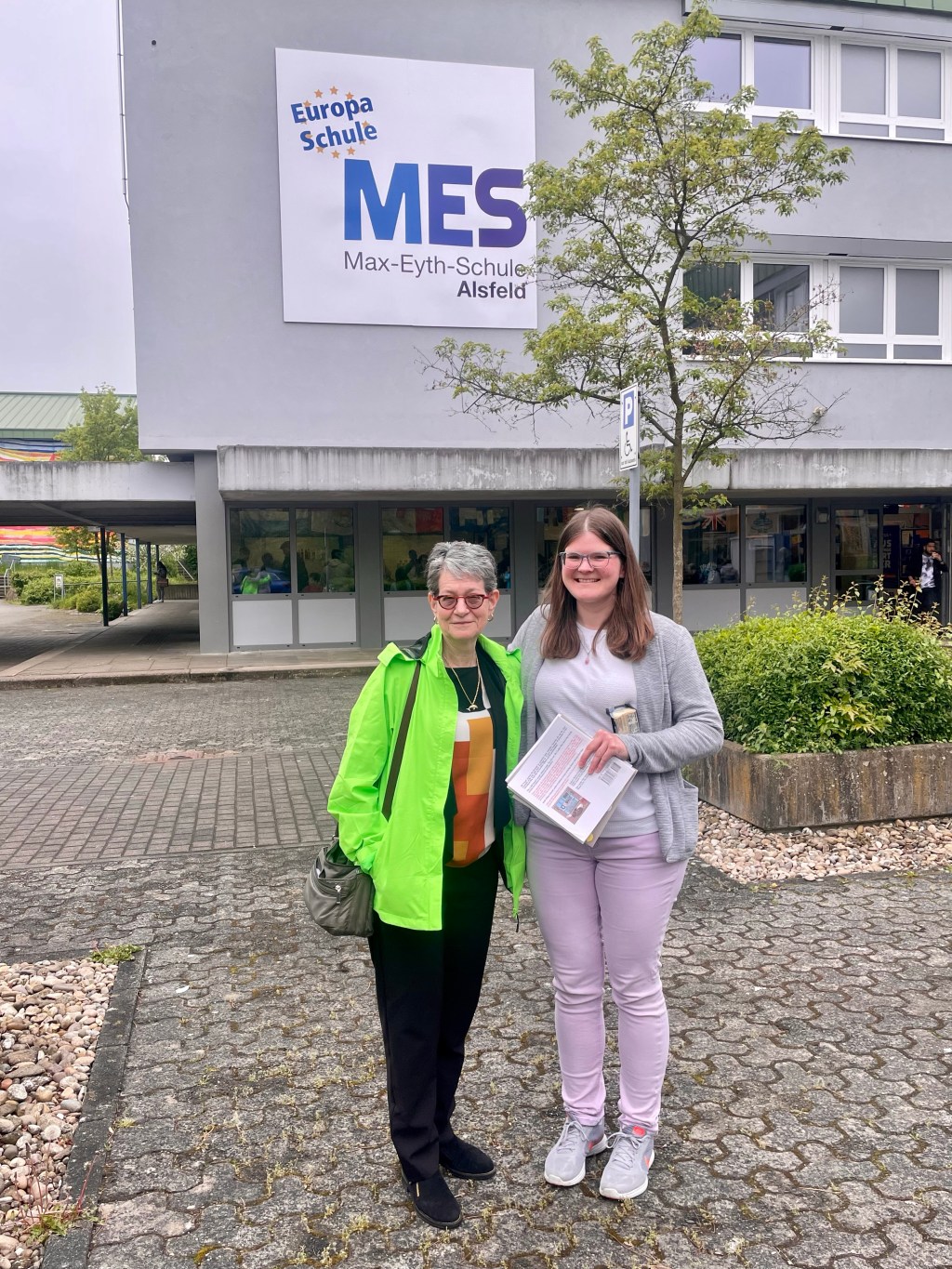
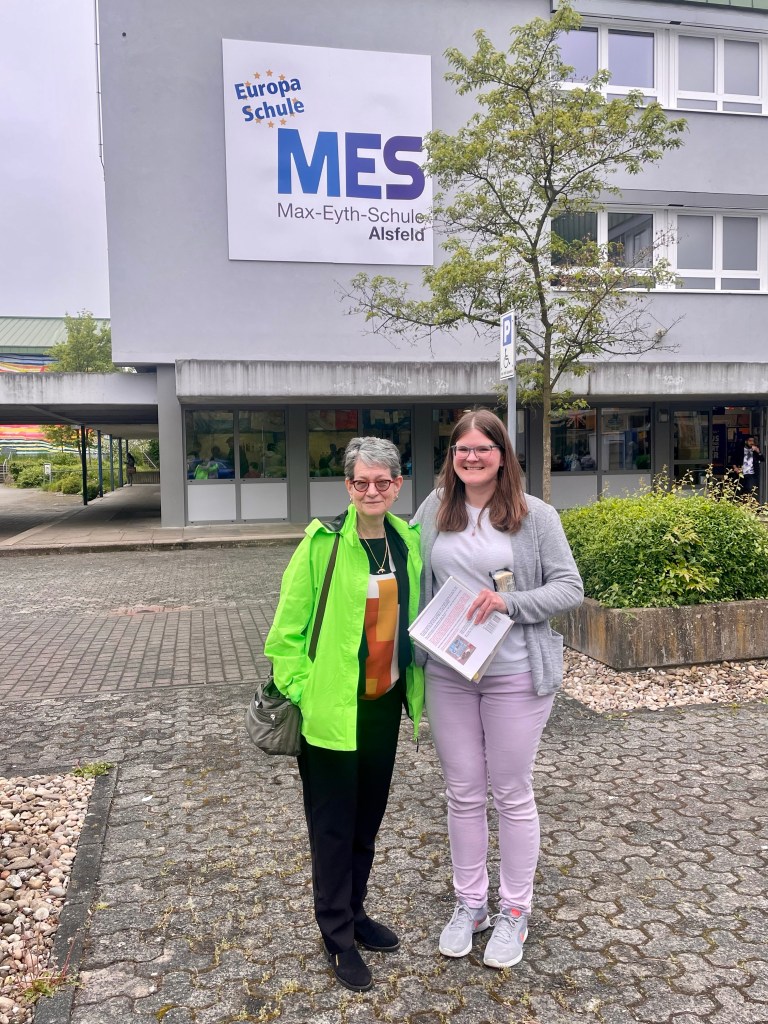
We were greeted by Sarah Schaefer, a smart and engaging English teacher at the Max-Eyth School. Sarah made this visit possible! Sarah and I have been talking for months on Zoom. The key, we thought, was to prepare a presentation that would bring to life the experiences of Jews who lived in town and were forced to emigrate or were murdered.

Alsfeld is the little blue dot on the map. It’s a 45 minute drive from our stop in Fulda yesterday. Alsfeld is 62 miles north of Frankfurt, with a population 16,000.

On this map, I showed the students the house where my family lived, the public school they attended and the synagogue where they prayed and where my grandfather was president. My family felt very German, yet my grandparents were smart enough to uproot their family, 8 months after Hitler took power, and move to Haifa.
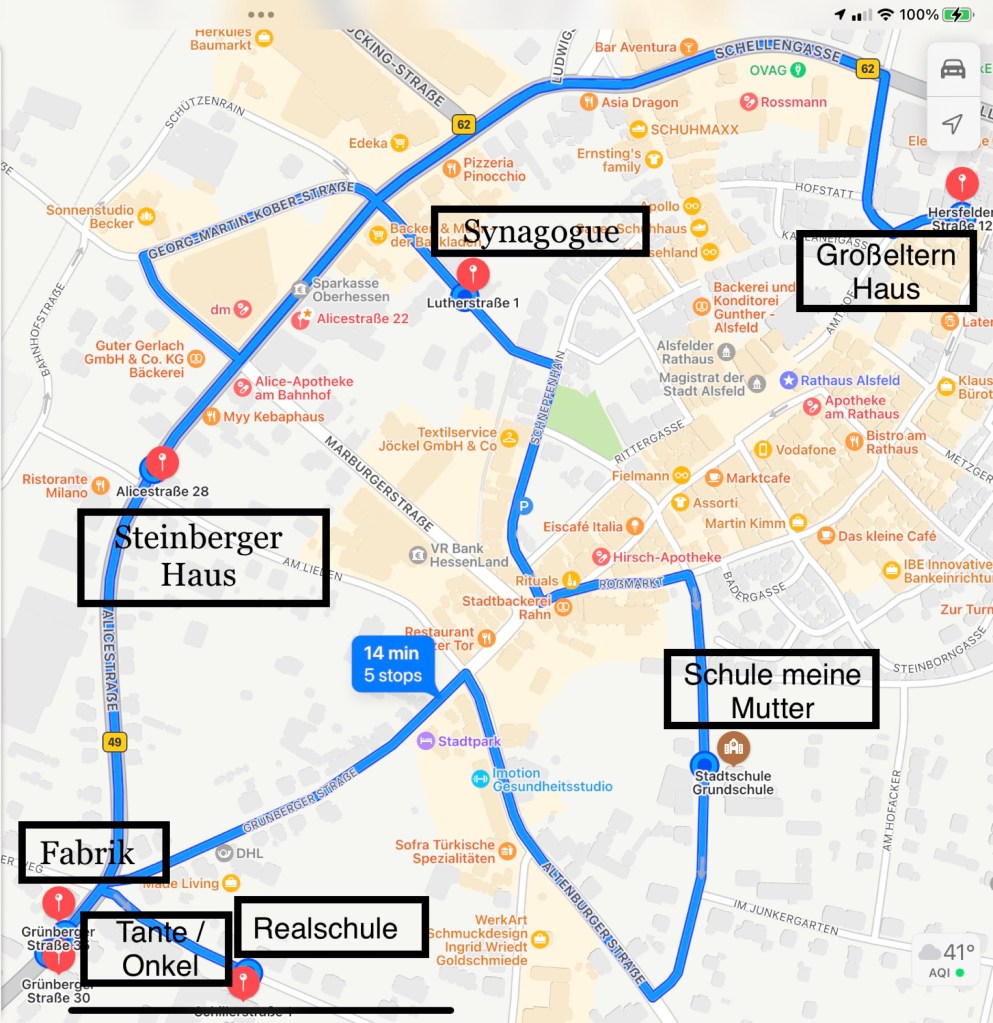
My Steinberger family house, the Fabrik (factory my grandfather owned), the Schule (school my mother attended), the house where my Tante and Onkel (great aunt and great uncle) lived, the synagogue and house of my GroßEltern (grandparents).

I showed the students lots of photos, including where my mother was born, where the synagogue stood and where my grandfather’s factory with 130 workers stood. Of course they knew all the locations. Alsfeld is a small town. One student actually lives in my mother’s old house, though he was not in attendance.

My mother’s house was across from the (yellow) train station.

Several students shared their thoughts and feelings. Ferdinand stayed to speak with with us and to be interviewed by the local museum, which filmed one of the classes. Ferdinand thinks that we should learn from the past. Some students apologized on behalf of their great-grandparents. One thanked me for sharing my story while others nodded agreement; she said my personal story and the setting in her own town made real the pain that went with emigration and the trauma that was passed on through the generations. Some mentioned that their ancestors never spoke about the Nazi times, or had said they were indifferent when the Jews disappeared. Others said they had great-grandparents who were in the SS.
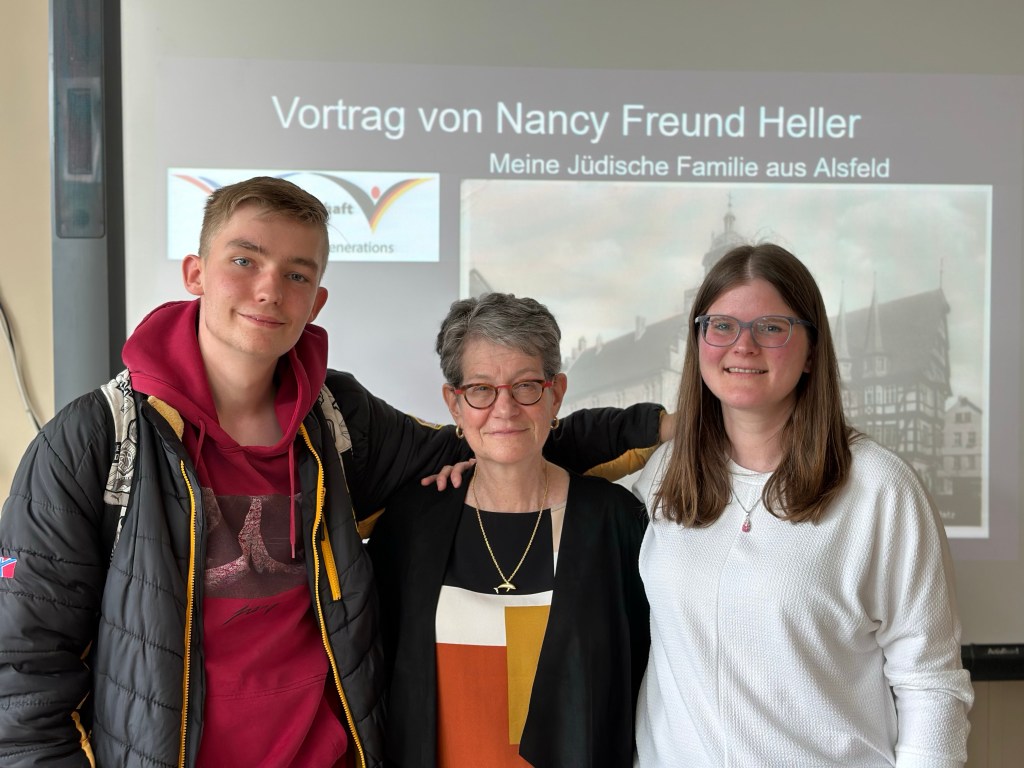
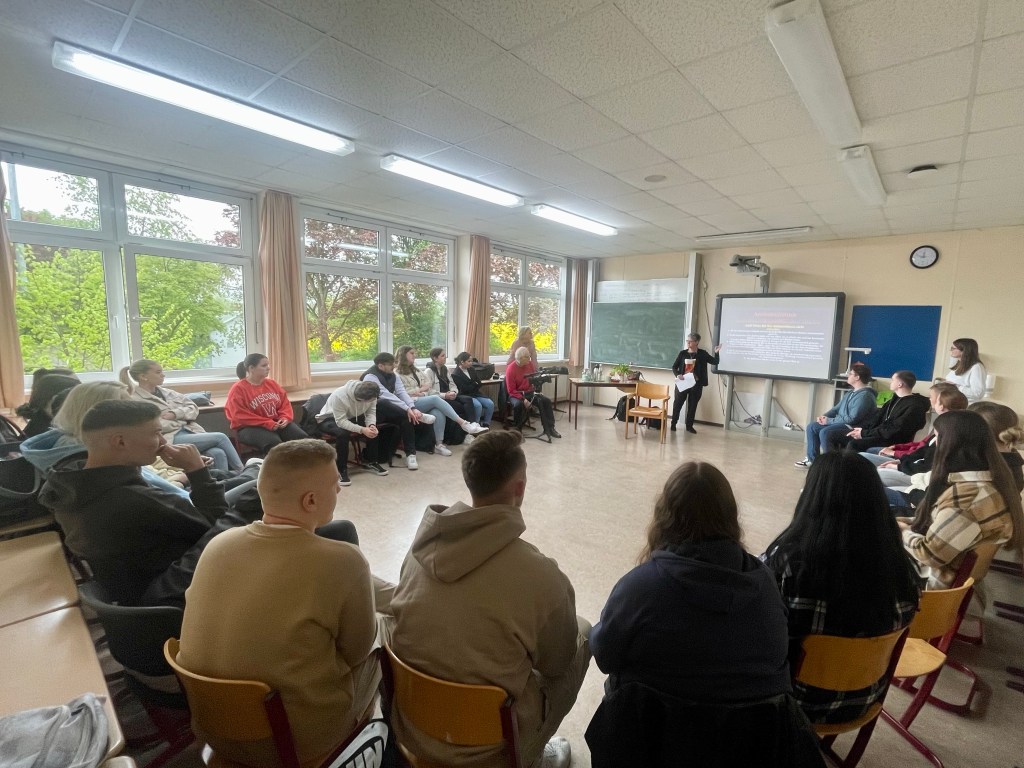
Ferdinand stayed well beyond the class time.
I spoke in German to about 75 students in three classes over 4 or 5 hours. Some of the students went to the same school as my mother.

History teacher Andreas Scheumann and his class joined us after a brief lunch. I somehow didn’t get a photo of him. His students were fully engaged and asked numerous questions.

I shared my complicated feelings about Germany. On the one hand, my home in suburban New Jersey was typically German, with German food and customs. When I came to Germany the first time, it felt much like home. On the other hand, many family members were murdered. It’s hard to reconcile except to believe in helping innocent young Germans to understand this history so it never repeats.

It will take time for the students and their teachers to process what happened to today. Millions of murders and millions of refugees are hard to fathom. The story of one family from your neighborhood is easier to grasp.

The teachers will speak with the students and share their reactions.

After class, we drove to Speier Haus in nearby Angenrod.
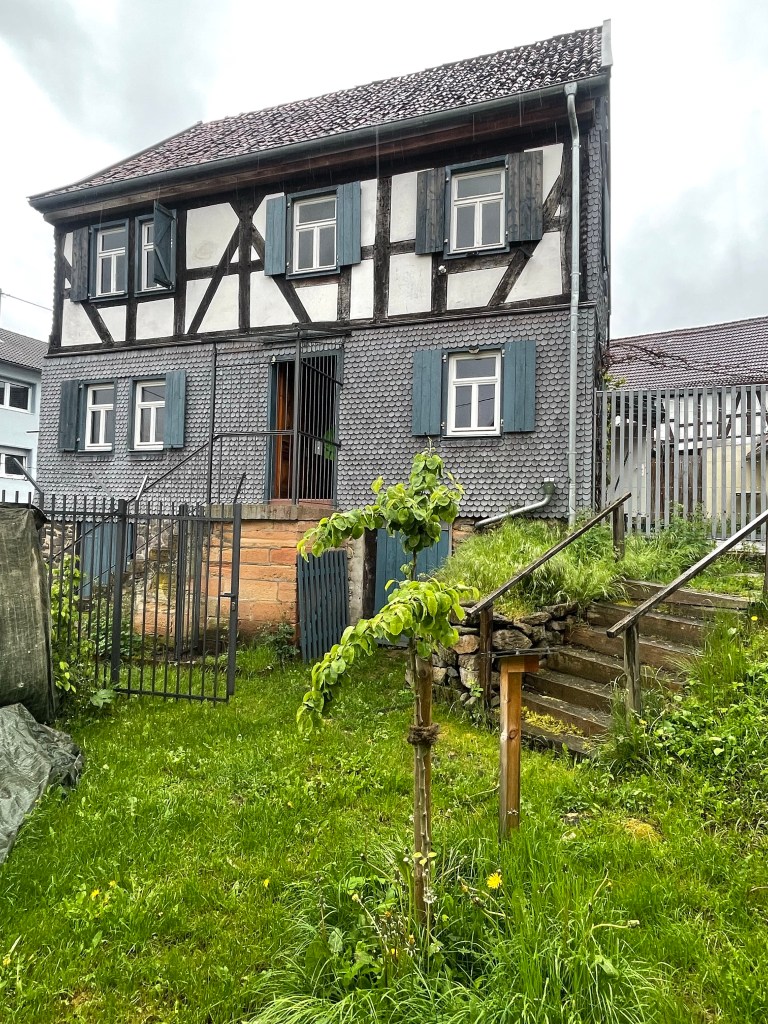
In 1942, Gestapo criminals forced the last 8 of Angenrod’s 247 Jews onto a truck to be deported and murdered. In protest, while the criminals searched his house, Leopold Speier got off the truck and cut down his family’s pear tree. In 2021, German students planted this pear tree as “a new sign of life in diversity and unity.”
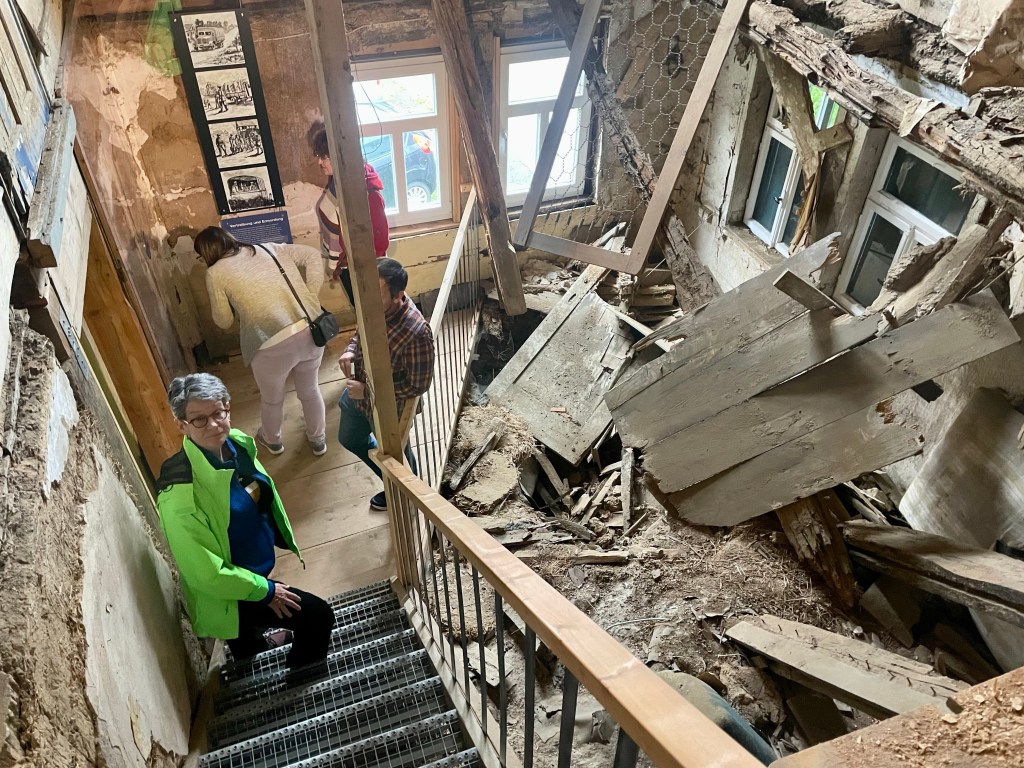
Some of the house interior was left untouched after Gestapo vandalism and the deterioration of abandonment.
A staircase records anti-Jewish obscenities from 1920 until the present: before, during, and after the Nazi era in Germany.

Dedicated volunteers have made Speier Haus into a center to educate students about the local Jews who were murdered or forced into exile; and to teach the students that Jews are not fossils, that We Are Still Here, even if not living in Alsfeld and Angenrod. I gave Speier Haus some Jewish ritual objects and information to help further their goals.

Then Jeffrey and I took our German friends to dinner. They gave me some sweet local treats and a book about Alsfeld published on the town’s 800th anniversary in 2022.

My brain is fried. It was a good day. A memorable day. An emotional day. And a German-immersion day.

To read prior essays, click HERE.

11 responses to “Essay #19 – Alsfeld – May 11, 2023”

  1. Jennifer Kawar Avatar
    Jennifer Kawar

    Hi Nancy, I am deeply moved by your blog post, mindful of the many months you spent studying and researching in preparation for today. Your photo of the quotes on the staircase is quite sobering.

    Like

  2. Again, totally amazing!

    Like

  3. Again, amazing Nancy!!!

    Like

  4. Ephy Torenberg Avatar
    Ephy Torenberg

    Nancy,
    Danke!

    Thank you for sharing your experience and feelings. I’m well connected with your emotions, and like you I see new Germany, respecting and remembering the past. Not brushing it under the carpet, but teaching it, and educating for the right values. That’s at least my impression and the openness and invitation for you to share it with the young students, support the right message. Keep being a great ambassador for the Jewish legacy and values, I know you are doing am amazing job and we are all very proud of you.

    Like

    1. Christopher Weber Avatar
      Christopher Weber

      Dear Nancy,

      I am just so impressed by your actions to teach newer generations and people all over the world (including us in Max-Eyth-Schule Alsfeld, Germany) about all the awful things happened to jewish people in the past. And sadly, it’s not over yet.

      Although we learn quite a lot in German schools about our own dark history and the amount of damage Germany caused – to hear all this from an affected person in such eerie detail was stunning and I can’t forget about that.

      Besides that, I have to say that I am really impressed how you found your own way to deal with this personal trauma. You aren’t silent. Instead, you go into an exchange with young people to preserve your family’s legacy and to make sure that something like the holocaust will never happen again.

      I’m glad that courageous and open-minded people like you and your husband exist and that you shared your personal story and thoughts on this topic with us (in German!).
      Thank you so much and stay tuned!!

      Liked by 1 person

  5. Deborah Ziffer Avatar
    Deborah Ziffer

    It takes a lot of guts to do what you’re doing. I am beyond impressed with your efforts to establish ties with the younger generation. And grateful!

    Like

  6. Christina Cutlip Avatar
    Christina Cutlip

    Nancy,

    I was deeply touched by your blog. What an amazing story! The students you talked to will always remember your family story and help the next generation to not forget what happened. The pictures also tell a powerful visual story. Thank you for continuing to change the world and making sure history does not repeat itself.

    Like

  7. Rabbi Charles Kroloff Avatar
    Rabbi Charles Kroloff

    Nancy
    Your father told Terry and me about your trip. Your report is very moving, bringing us close to the town then and now. Thank you.
    Rabbi Chuck Kroloff

    Like

  8. Kol haKavod! I could not do what you are doing — nor have any inclination to do it or even visit Germany. But I must credit the effort, both emotional and other, that you have taken to do this important task of keeping the memory alive.
    Eva

    Like

  9. Following you from Beaufort, Nancy. We miss you but we’re with you in spirit.

    Like

  10. Nancy, interested in any information you have about Alsfeld during this time. Could you please email me at meghankfish@gmail.com? Thank you!

    Like

Leave a reply to Deborah Ziffer Cancel reply