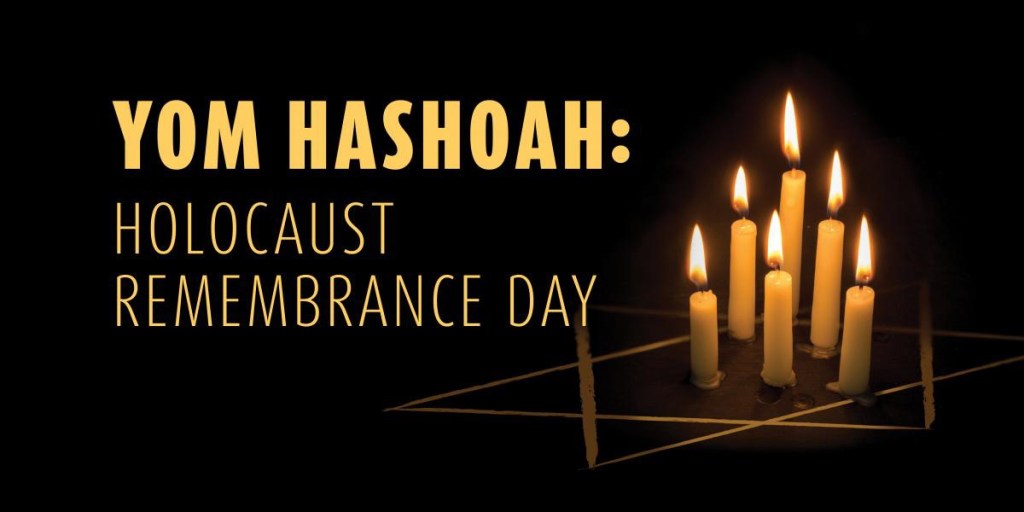
Tonight (after sundown) begins Yom Hashoah, Holocaust Remembrance Day, and we remember the lives of those forced to flee and those murdered in Shoah.
Thanks to good luck and some smart grandparents, ich bin hier, I am here. I’ve been interested in family history for decades, grilling my parents on their past and more recently digging deeply into genealogy research and trying to make sense of it all. There is little sense to be made, but there is much to be learned.
My family on both my mother and father’s side, lived in Germany for hundreds (perhaps thousands) of years. I’ve traced us back to the 16 and 1700’s. One of my Freund forebears was a Schutzjude, or privileged Jew, with the right to own land in a small town called Kleinwallstadt or small walled town. Next month, my dad via Zoom and I in person, will speak to high school students in this town about the Nazi period and my family history in this town. My great grandfather fought in the Franco-Prussian war and a monument in the town bears his name along with the other town fighters. This great-grandfather ran a dry goods store, was a wealthy man and a leader of the Jewish community. I will tell the students that under other circumstances, I might have been their neighbor.

Not all my Freund forebears made it out of Nazi Germany. On this trip, a Stolperstein, or stumbling stone will be placed for my blind great aunt Karoline in Nürnberg, my father’s birthplace. Next year, 2024, my great uncle Max and great aunt Bella will have stumbling stones, also in Nürnberg. I will be there.
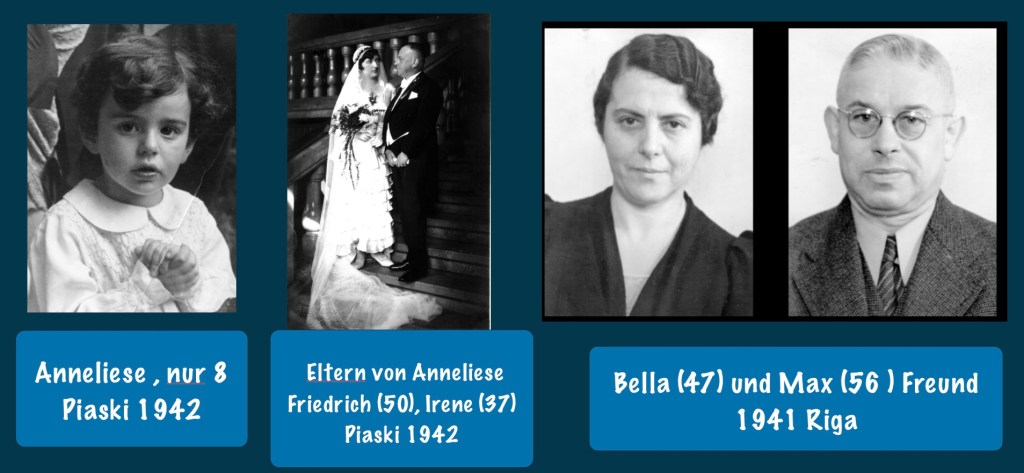
Karoline’s daughter, (Irene) son-in-law (Friedrich) and granddaughter (Anneliese) were all murdered and the city of Munich will place memorials next month on the sides of buildings, thinking that the Jews were stepped on enough and it’s better to have memorials on eye level. As part of these memorials, I agreed to honor the siblings of the blind aunt’s son-in-law. I spent almost a year researching their past and writing their biographies. I will deliver their eulogies in German, which I’ve been studying for the last six years. Of course I never knew any of them. My dad, now 96, remembers walking his blind aunt across the street in Nürnberg.
My dad’s father, Hugo Freund, was rounded up in Nurnberg, a hot bed of the Nazi party even before Hitler took power. Hugo thought things would blow over until he and the other Jewish men were badly beaten and forced to run around a track until exhaustion. That was enough. With permission from the American consulate in Stuttgart in 1937 (a miracle unto itself), my 11 year old dad and his family managed to get a visa from a distant cousin, money for tickets from a rich brother-in-law, exit permits and a new life.
My mother’s family lived in a small, pretty old town, Alsfeld, with 16,000 inhabitants an hour north of Frankfurt. Jews lived there for maybe 500 years. Next month, I will speak to 100 students in my mother’s home town, kids in the same school that my mother and aunt attended. It will be surreal to show them a town map with my mother’s house, the family business, the synagogue. All of these kids will know the locations. I will show them photos of the business my grandfather ran with the 100 employees standing outside. Some of the employees were their great-grandparents. I’ve asked the teachers to show the photo to the kids so they can ask their parents if they recognize their family. This will be up close and personal and uncomfortable for all of us.

I will show these Alsfeld students Stolperstein of my great aunt Therese and her husband Markus that lie under their noses in town in front of the house where they lived, where it’s clear that they were murdered by the Nazi’s. I will tell them that a Nazi thug came to shoot my grandfather in 1933, around Purim. My grandfather’s workers warned him to get out of town, and my grandfather – Adolf Steinberger- was smart enough to know that without civil liberties one cannot live. In August 1933, taking one last look at the town, as their father advised, my 13 year old mother and her family moved in the dead of night, to Haifa.

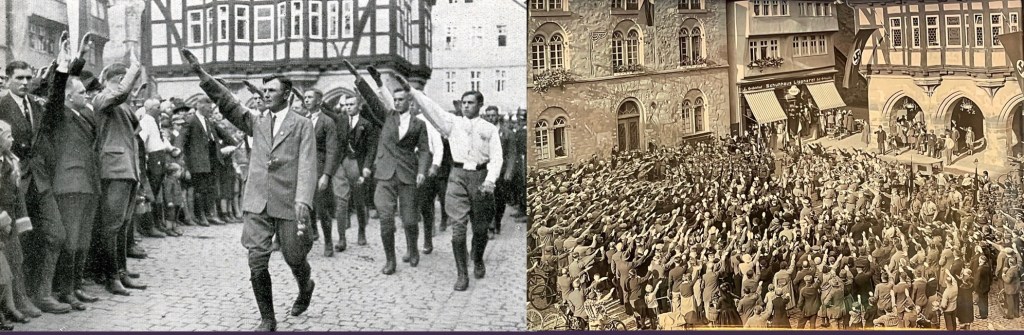
In both my mother and father’s towns, I will show them photos of local townspeople (their families) chanting antisemitic slogans that my parents had to hear. Wenn das Judenblut vom Messer spritzt, dann geht’s noch mal so gut. “When Jewish blood spurts from the knife, things will be good again.” It will likely send shivers down their spines and scared my parents half to death. It’s hard to imagine the scene of hundreds of local townspeople marching, saluting and chanting slogans against their neighbors.

And from all this horror, I hope to help all of us learn from the past, to vote for freedom. I hope that they come away feeling that we all have a responsibility to fight for civil liberties and keep despots from ruling our lives. Remembering is not enough. We have to do something.
I have mixed feeling about Germany, where a part of me feels so at home. Germany has a long history of Jew hatred and robbed many of their lives. Yet this new generation, like myself, was born after the war. Growing up, the shadows of the Holocaust were ever present. From these ashes, I believe that we, Germans and Jews together, can and should work do our part for Tikkun Olam, the repair of the world.
To read prior essays, click HERE.


 Germany: Roots & Remembrance
Leave a comment